2026-09-22 • 5 min read • Connect
How to Make Your Company Documentation Queryable by AI Agents
How to turn the help center or handbook you already maintain into an MCP server, and how to keep public and private material on separate servers.
Support already knows the refund rule. They also know where it lives, because they have opened that help center article a hundred times. An agent does not, until that article is something it can call.
Making company documentation queryable means deploying the documents you already stand behind as an MCP server, then connecting the agent your team uses. It does not mean pointing one URL at the entire intranet.
What queryable means here
The agent can ask a question and get a passage from a document you chose, with a link a person can open. Public customer docs and employee-only docs are different servers. Mixing them is how a private rule ends up on a URL you might paste into a demo.
MCP Studio will index a help center, a handbook PDF, or an internal site the indexer is allowed to read.
Why start from three questions
You already have the questions. Write down three that people ask in Slack, each with a written answer. If you cannot name the page, the documentation is not ready to connect. The editing pass is Make your documentation AI-ready. You can still connect what you have and learn which questions fail. You should not connect five wikis in order to find out.
Customer articles can be a public server. Anyone who can read the help center can read the same words through the agent.
Employee-only material is a private server with tokens. Who you hand the token to is the access list. Read Who can reach your MCP server before you share the URL. Cursor's header is Give Cursor access to your private documentation.
Salary bands do not go on the customer server. They go on a different, private one, if they go on a server at all.
Make the server in MCP Studio
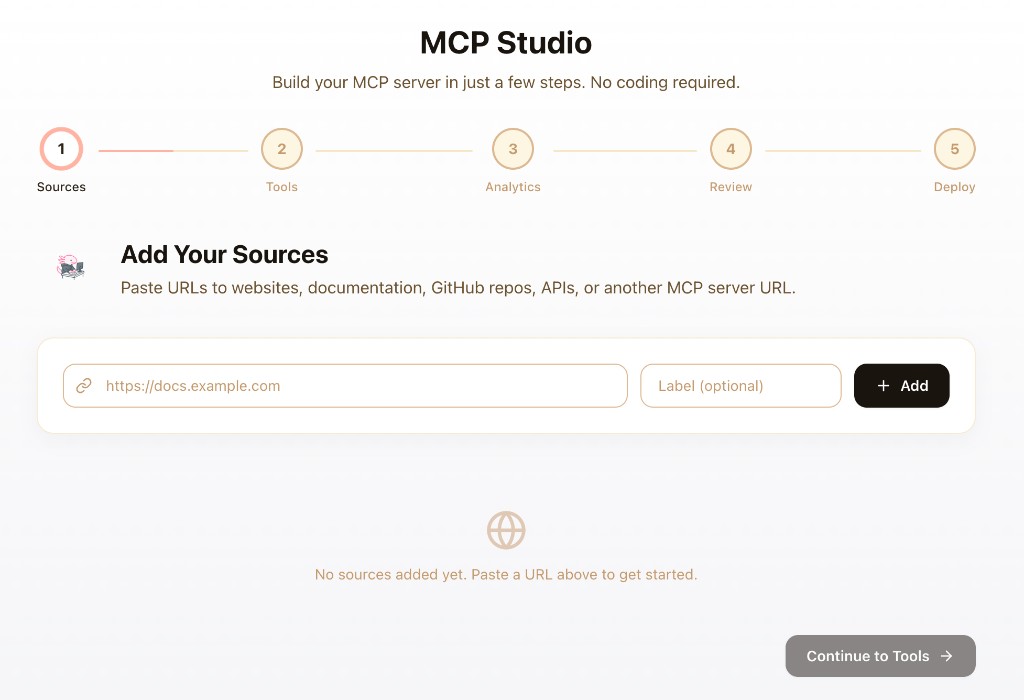
MCP Studio is the no-code builder on Appa Tools. Open the wizard. You do not write any code.
- Name it for the set.
Customer policiesorEmployee handbook. - Add only the sources that contain the three answers. A help center URL, or a handbook PDF. The PDF path is Turn a PDF into an MCP server.
- Choose search and question answering. That is enough for policy questions.
- Set visibility before you deploy. Public for the help center. Private for the handbook. Deploy, then connect the support team's Claude workspace using Give Claude access to your documentation.
The server URL:
https://appatools.com/mcp-studio/api/mcp/your-server-name
Check that it works
Ask the question in the words support actually uses.
What do we refund if a customer cancels eight days before arrival?
Accept the server when the citation is the cancellations article and the refund rule matches the page.
Then ask for something you deliberately left off this server.
You: What is the salary band for a support lead?
Assistant: Nothing in this server's content covers salary bands. The closest material is the cancellation policy, which is a different subject. You would need to add that document as a source.
If the reply is not what you expected
Two documents that contradict each other need a choice. Prefer the one the company treats as current. A retrieval rule can say that. See retrieval rules. An old PDF export sitting next to the live help center will keep winning questions until you disconnect it. Disconnecting deletes what was indexed from that file.
Questions the server cannot answer, asked in the customer's words, are the backlog. How to read them is Find documentation gaps with MCP analytics.
Make your company docs queryable today
Make your company docs queryable today. Open MCP Studio with three questions already written. Add the help center, deploy, and ask the cancellation question. Keep the server when the citation is the article a person would have opened.