2026-09-22 • 5 min read • Build
How to Create an MCP Server From Multiple Sources
Why one job often lives in two places, how to put a docs site and a repository on one MCP Studio server, and how to tell which source answered.
The upload limit is published in the docs. The sample client that handles a rejected upload lives in the repository. A single source answers one of those questions and has nothing to say about the other.
An MCP server can hold both, and the client still calls one URL. The work is deciding why each source is there, then asking a question that should cite one and a question that should cite the other.
What a multi-source server is
It is one hosted endpoint over more than one body of material. The client does not need a second connection. You need a reason for the second source. If you cannot write a question only that source can answer, it is not ready to add.
MCP Studio accepts documentation sites, websites, GitHub repositories, uploaded files, and MCP endpoints other products already publish. The free tier includes two sources on a server. Adding more is described in the billing guide.
Why each source earns its place
Documentation answers the contract. Methods, required fields, limits, the sentence a customer is allowed to rely on. "What is the maximum upload size?" should cite the docs.
A repository answers the implementation. The function that checks the file, the sample that handles the error, the note about the raw request body. "How does the sample handle a rejected file?" should cite the repository.
A PDF answers the rule that was never published as a site. A handbook or a spec export. How that upload works is Turn a PDF into an MCP server.
Another product's MCP endpoint answers its own docs. GitBook publishes one with the site. You can put that endpoint beside your repository so both answer from one server. The walkthrough is Your GitBook docs and your code behind one MCP endpoint. That connection retrieves. It does not call the remote server's action tools.
A private GitHub repository locks the whole server private until that source is disconnected. Adding sources covers the GitHub sign-in. Who can call the URL afterward is Who can reach your MCP server.
Make the server in MCP Studio
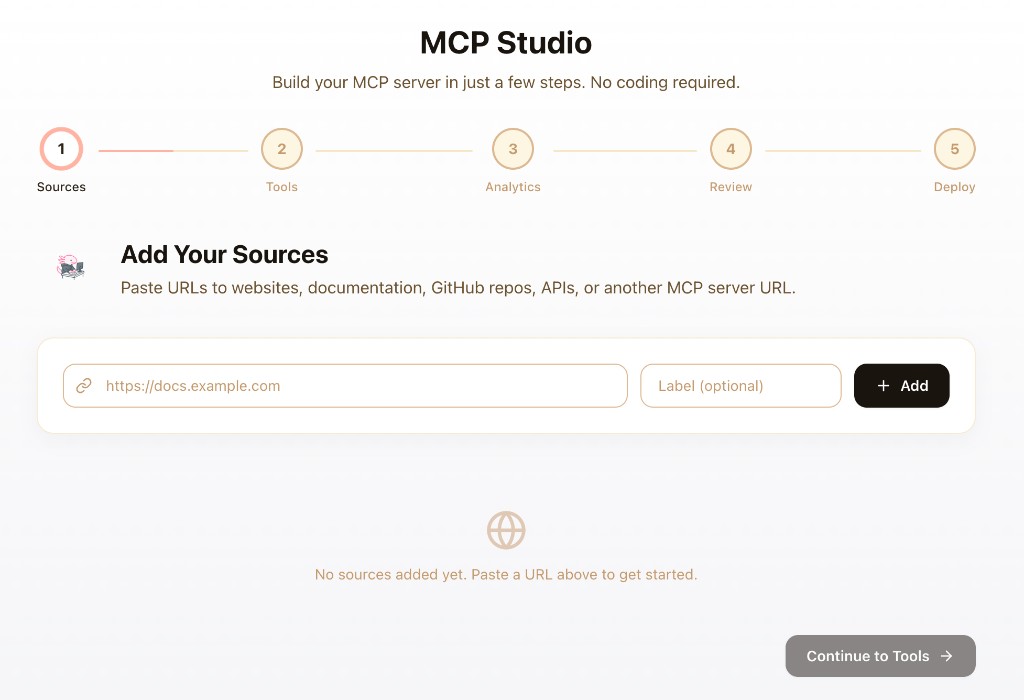
MCP Studio is the no-code builder on Appa Tools. Open the wizard. You do not write any code.
- Name it for the job, not the inventory.
Paymentsis clearer thanDocs plus repo. - Add the documentation URL first, then the repository. Each source should match one of the questions you wrote down.
- Choose tools that match the questions. API reference lookup for the docs, code example lookup for the repository, plus search. The tool guide is how those differ.
- Deploy and wait until both sources finish. An answer from a source that is still indexing is not a fair test.
Copy the URL from the setup page:
https://appatools.com/mcp-studio/api/mcp/your-server-name
Check that it works
Ask the two questions separately, in a fresh chat, with the server enabled.
- What is the maximum upload size? Expect the docs.
- How does the sample handle a rejected file? Expect the repository.
Open each citation. The page should be the one you named, not a neighboring README that mentions uploads in passing.
Then ask something neither source covers.
You: What is our incident escalation policy?
Assistant: Nothing in this server's content covers incident escalation. The closest material is the upload guide, which is a different subject. You would need to add that document as a source.
If the reply is not what you expected
When the repository keeps answering the policy question, prefer the docs for limits and authentication. A retrieval rule can prefer a source, or require that a passage from it is included. It cannot invent an answer the sources do not contain. The guide is retrieval rules.
When you cannot tell which source was wrong, the server is too wide. Unrelated sites on one endpoint make the test impossible. Split by job. A focused server is the same advice as Ship a docs MCP built around one real task.
Disconnecting a source deletes what was indexed from it, including excerpts kept for analytics. The other source on the server stays.
Put two sources on one server today
Put two sources on one server today. Open MCP Studio with the two questions already written. Add the docs and the repository, deploy, and ask each question once. The citations tell you whether the second source earned its place.