2026-09-22 • 5 min read • Build
How to Build an MCP Server Without Coding
What an MCP server is, why you would host one without writing code, and how to deploy it in MCP Studio from one source.
An MCP server is the address an AI client calls when it needs your material. Writing one means a host, a protocol implementation, and a way to search your pages. You can skip all three and still end with a URL Claude, Cursor, or VS Code can call.
MCP Studio is the no-code builder on Appa Tools. You add a source, choose the tools, and deploy. The server is hosted. You do not write any code.
What you are building
An MCP server is a standard interface. Model Context Protocol is how a client discovers the tools a server offers, calls one, and reads the result. For a content server, the client searches your pages and gets passages back, each one linked to the page it came from.
You are deciding three things the code would have encoded anyway: which material the client may see, which tools it may call, and who may call the URL. The short click-through of the same wizard is Create an MCP server in less than two minutes. This post is those three decisions.
Why build it this way
You already have the page. A payments doc that names the authentication header is more useful to the client than a paragraph it invents. The server is how that page gets into the chat without you pasting it.
One source is enough to learn the shape. A documentation site, a GitHub repository, a website, a PDF, or an MCP endpoint another product already publishes. Add a second source only when it answers the same job from another angle. That case is Create an MCP server from multiple sources.
Published docs and a private handbook are different servers. A public URL is right for a help center. A runbook is not. Who can call the server is Who can reach your MCP server.
The wizard is the part that takes about a minute. Indexing runs afterward, in the background. A large site is not a two-minute story even when the clicks are.
Make the server in MCP Studio
Write three questions the source already answers before you open the app. For an upload guide they might be: which header authenticates an upload, what the size limit is, and what the sample does when a file is rejected. If you cannot write them, you do not yet know whether this server is the right shape.
Open the wizard and work through it in order.
- Name it for the job.
Payments API Docsstill means something in six months.My serverdoes not. - Add one source tied to that job. Paste a documentation URL, a website, a GitHub repository, or an existing MCP endpoint, or upload a file. A website source is indexed up to 5,000 pages, so a section of the site is easier to judge than the whole company domain.
- Choose the tools the client can call. Search and question answering cover most chats. Add API reference lookup or code example lookup when the questions need an endpoint or a sample. The tool selection guide is the list.
- Deploy. The endpoint exists straight away and indexing starts in the background. Wait until the source shows complete on the dashboard before you judge the answers.
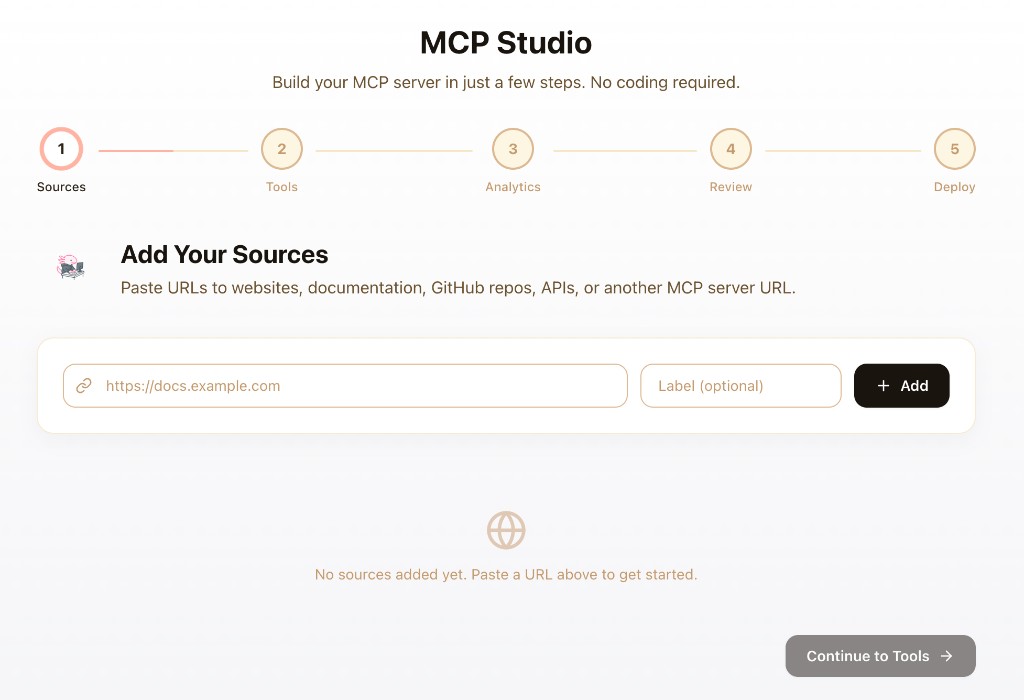
Copy the server URL from the setup page. It looks like this:
https://appatools.com/mcp-studio/api/mcp/your-server-name
That is the address a client connects to. The wizard page and the dashboard are not. The free tier includes two sources on a server and three servers on an account. Limits are on the billing guide.
Check that it works
Ask the three questions after indexing finishes. Compare a specific, not the mood of the paragraph: a header name, a limit, an error code. Open the cited page and read around the passage.
Then ask something the source does not cover. When nothing in your content is a real match, the server says so before it says anything else.
You: What is our incident escalation policy?
Assistant: Nothing in this server's content covers incident escalation. The closest material is the upload guide, which is a different subject. You would need to add that document as a source.
Two known answers and one deliberate miss tell you the server is answering from your source. If the client never shows a tool call, it wrote from general knowledge. Connection steps for Claude, Cursor, and VS Code are in the connection guide.
If the reply is not what you expected
Change one thing, then ask the same question again. Rephrase it in the wording the source itself uses. Add the page that holds the answer when the question was never covered. Confirm indexing has finished before you rewrite a heading.
A PDF with no URL is a different first source. That path is Turn a PDF into an MCP server.
Build your first MCP server today
Build your first MCP server today. Open MCP Studio, add one source, and deploy. The wizard is about a minute. The first question you already know the answer to tells you whether to keep the server.