2026-09-22 • 5 min read • Connect
How to Connect Your API Documentation to an AI Agent
How to point an agent at your API reference with MCP Studio so it retrieves the method, path, and required fields instead of inventing a call.
Ask a coding agent how to create a refund and it will invent a reasonable REST
call. Yours might be POST /v1/refunds with a required payment_id, and a
refund above the captured amount returns amount_exceeds_capture. None of
that is something the agent should guess.
Connect the API reference as an MCP server, with API reference lookup selected, and the agent can retrieve that page. The agent does not gain your production credentials. It reads the documentation.
What you are connecting
You are connecting the reference: the pages that state the method, the path, the required fields, and the errors. A marketing homepage and a getting started tutorial are useful to people. They are a noisy source when the question is the contract.
A developer portal with both guides and a reference is the wider version of this setup: Build an MCP for your developer documentation.
Why the reference has to be the source
Three facts are enough to catch a guess. Method, path, and one required field. If any of the three is wrong, the agent did not use your page.
The error name is the fourth fact. amount_exceeds_capture is not a name
an agent should invent. If the reply uses a generic "bad request" and your
reference names the code, the citation is the wrong page or there was no
citation.
Staff notes do not belong on the partner server. If the staff portal includes internal limits, that is a second, private server. Two servers, one of them private, matches Who can reach your MCP server.
Make the server in MCP Studio
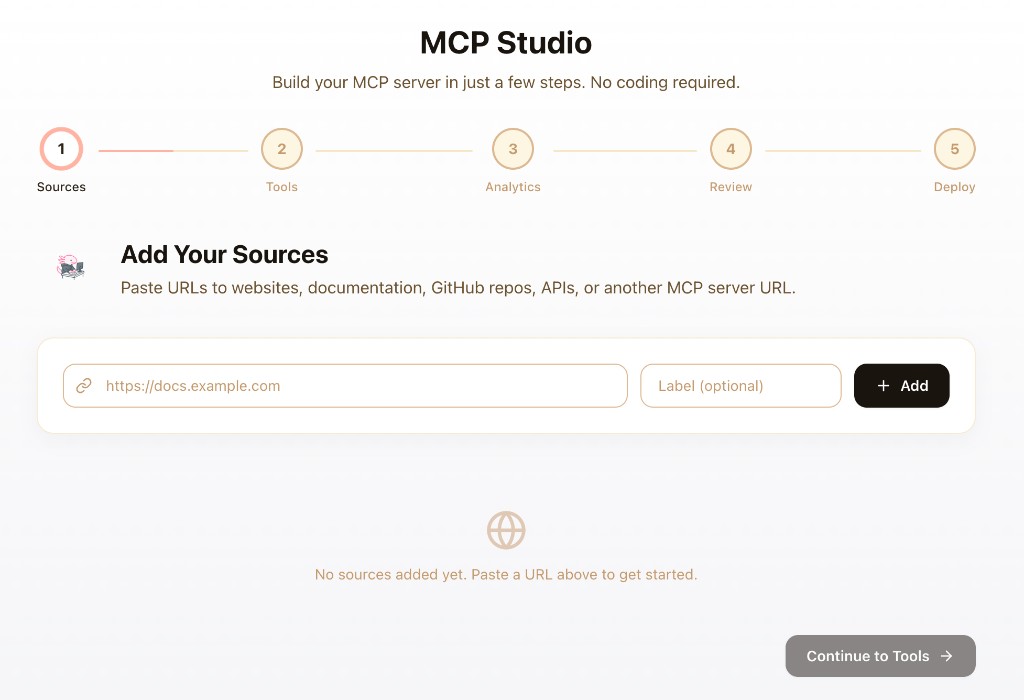
MCP Studio is the no-code builder on Appa Tools. Open the wizard. You do not write any code.
- Name it for the API.
Billing API referenceis the name you want in the client's server list. - Paste the reference URL, not the homepage. If the portal mixes guides and a reference, start the source at the reference section so a tutorial does not outrank the contract.
- Select API reference lookup and documentation search. Add code example lookup when a repository holds the samples you want cited. The difference is in the tool guide.
- Deploy and wait for indexing. Then connect the agent using Connect to AI tools.
The URL the agent calls:
https://appatools.com/mcp-studio/api/mcp/your-server-name
Check that it works
Ask for the method, the path, and the required field on create-refund, and for the error when the amount is too high.
All four should match the reference, with a link to the page. Open it.
Then ask for an endpoint the reference does not document.
You: How do I create a store credit from the API?
Assistant: Nothing in this server's content covers creating a store credit. The closest material is the refunds reference, which is a different subject. You would need to add that document as a source.
If the reply is not what you expected
When the agent describes a generic refund call, it did not call your
server. Confirm the server is enabled and that the URL contains /api/mcp/.
When the docs and the SDK disagree, keep the documentation as the contract and the repository as a working call. A retrieval rule can prefer the reference for endpoint questions. See retrieval rules and Create an MCP server from multiple sources. The repository steps are Give an AI agent access to your GitHub repository.
Which endpoints people ask about shows up as tool and source breakdowns on the free tier. The question text is Core analytics. The page that was returned is Action. That split is What the questions people ask your docs can tell you.
Connect your API reference today
Connect your API reference today.
Open MCP Studio, paste the reference URL, turn on API reference lookup, and
deploy. Ask for POST /v1/refunds. If the citation is that page, keep the
server.