2026-09-10 • 6 min read • Build
When the Right Answer Is the File Itself
Most of what a team knows was never published as documentation. It is in a handbook PDF, a spreadsheet, a slide deck, or a brand image. Here is how an AI assistant can use those, and what it can hand back.
Our promise is that you can build absolutely anything, with the right context. For most teams, a good deal of that context was never published anywhere.
Think about where the answers actually live where you work. The operations handbook is a PDF someone revises twice a year. Last quarter's numbers are a spreadsheet. The winter planning decisions are a slide deck. The exact shade of the company blue is an image file with four other swatches beside it.
The questions no published guide answers
"What do we refund if a customer cancels a charter eight days out?" The answer is a table on page seven of a handbook. "Which vessel used more fuel than it should have last week?" That is a spreadsheet, and answering it means reading one row and comparing it against a threshold written down somewhere else entirely.
These are the questions people ask each other rather than ask a search box, and they are slow because finding the material takes longer than reading it. That is the gap files fill.
What your assistant can read
You upload a file and it becomes searchable context, the same as a documentation site or a code repository would.
| You upload | Your assistant gets |
|---|---|
| Each page separately, so a citation says page 7 rather than "the handbook" | |
| Word document | The document, structured by its own headings |
| Spreadsheet | Each sheet, with rows read as records so a value keeps the name of its column |
| Slide deck | One slide at a time, so a citation points at the slide |
| Image | A written description of what is in it, plus the image itself |
| Text, Markdown, HTML | The content as written |
| Zip archive | Everything inside it, in one upload |
Two details worth knowing. Spreadsheet rows keep their column names, so a row reads as "Vessel: Braewick Trader; Variance: 15.6 percent" rather than as three numbers with the header long since scrolled out of view. And every passage keeps an address you can open, so when an answer cites page 9 of your handbook, you can go and look at page 9 of your handbook.
An image comes back as the image
Ask an assistant to write a customer email using your brand kit. A description of your logo does not help it, and neither does a hex code on its own. What helps is the file.
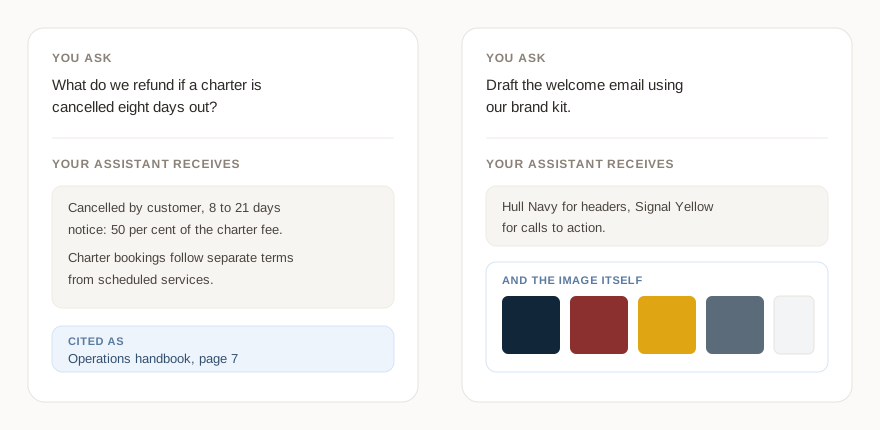
So images are handed back as images. Your assistant receives the picture, not a paragraph about the picture.
You: Draft the welcome email and use our brand colors.
Assistant: Here is the draft. I have used Hull Navy for the header and Signal Yellow for the button, from the livery specification, and I can see the chevron mark in the brand image you have connected.
The written description still matters, because it is what makes the image findable at all. An image carries no words for a search to match, so a model reads it and writes down what is in it. Anything written that way is labeled wherever it appears, so when you check a citation you know whether you are reading text taken from the file or a description written from it.
We tested it by inventing a company
You cannot judge a feature like this by uploading a file and being pleased that something came back. So we built a test we could fail.
We invented a small ferry operator and wrote its paperwork: a twelve page operations handbook, a two sheet sailing log, a berthing trial report, a winter briefing deck, and a livery specification image. Then we wrote 26 questions whose answers we already knew.
The material is difficult on purpose. Three weather limit tables look nearly identical and hold different numbers. Two refund policies are worded similarly and apply to different kinds of booking. A trial report contradicts the handbook it belongs to. And it says nothing at all about several topics it otherwise covers in detail, so we could check what happens when the answer is genuinely not there.
For 16 of the 18 questions the files did answer, every fact we were looking for came back in the passages the assistant received. Questions worded nothing like the material, asking "what wind speed suspends a Class B sailing" against a table that only says "Suspended, above 39 knots", were answered correctly every time.
That is our own material and our own questions, so read it as a record of how we test rather than as a score against anyone else. Build something similar for your own files and you will learn more in an afternoon than any figure of ours can tell you.
The part we are proudest of: it tells you what your files do not cover
Our test set deliberately included questions the paperwork could not answer, because the useful behavior is not just finding things.
When nothing in your content genuinely matches the question, the reply says so before it says anything else, and your assistant is told to pass that on rather than assemble something from whatever was closest.
You: What is the crew uniform standard?
Assistant: Nothing in the connected files covers uniform standards. The closest material is the crew rostering and rest rules, which is a different subject. You would need to add that document as a source.
That is not an impressive answer. It is an honest one, and it is the difference between a tool you can rely on and a tool you have to check behind.
Three things worth knowing before you upload
A single file can be up to 4 MB, and a zip archive is how you do a batch. Put a folder of documents into one zip, upload it once, and each file inside becomes its own searchable source with its own citations.
A server with a file on it starts out private. Only you can reach it until you decide otherwise, because you are the only person who knows whether the document you just chose is confidential.
Scanned pages need to be text first. If a PDF is a photograph of a document rather than a document, there are no words in it to index, and you are told so at the point you choose the file rather than later, from an answer that was quietly incomplete.
What this means if you use MCP Studio
Open the wizard, drag your files in, and deploy. The endpoint works with Claude Desktop, Cursor, Windsurf, and anything else that speaks MCP, and you can mix files with a documentation site and a code repository on the same server so one endpoint covers all of it.
The material a team relies on is rarely the material a team has published. Being able to point an assistant at the handbook, the spreadsheet and the brand image is what makes the difference between an assistant that knows your product and one that knows your company.
Read more in uploading files, or see what's new.